
Purpose of this paper. This paper separates three measures that are routinely collapsed into one: the nominal advance rate a facility contracts for, the maximum effective advance rate that facility can actually deliver once reserves and other accounts are funded, and the effective advance rate the facility achieves in daily operation. The distance between them is not noise. It is capital, and it belongs to someone.
Executive summary
Sponsors and their structuring advisers spend enormous effort extracting the last basis points of credit enhancement from lenders and rating agencies. That effort is worthwhile. It is also, on its own, incomplete. Credit enhancement levels and their corollary, advance rates, set a ceiling on the financing available against a pool of collateral. They do not describe what the facility delivers.
Granite Pass measures three distinct rates on every facility we administer.
— Nominal advance rate. The contractual rate — what the documents say the facility will lend against eligible collateral.
— Maximum effective advance rate. The best result the facility can produce once reserve accounts, yield supplement accounts, overcollateralization, ineligibility and concentration limits are funded and observed.
— Effective advance rate. The rate actually achieved, calculated daily and averaged across at least two full collection periods.
Between the first two sits a structural gap, fixed by the transaction documents and closable only through structuring and amendment. Between the second and third sits an operational gap, created every day by allocation frequency, draw frequency, cash treatment, data completeness and waterfall cadence. The two gaps have different causes, different remedies and different owners, and a sponsor that does not distinguish between them will generally close neither.
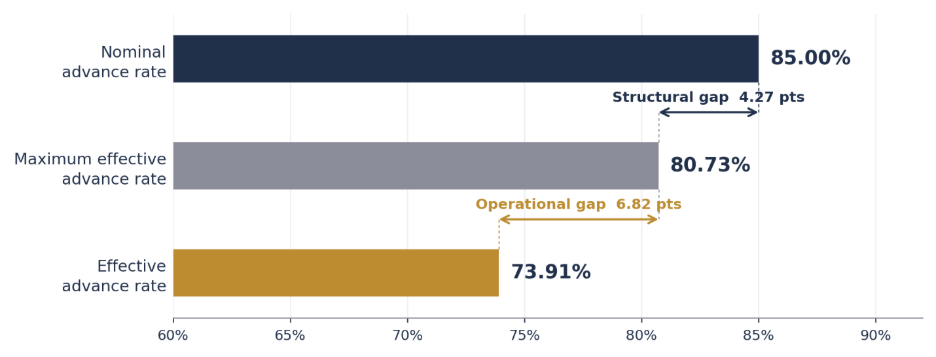
Figure 1 The three rates for the illustrative facility used throughout this paper. The total gap of 11.09 points represents $110.9 million of collateral funded with corporate rather than securitization capital.
The central claim. The borrower’s mandate is to move the maximum effective advance rate toward the nominal advance rate. Program administration’s mandate is to move the effective advance rate toward the maximum effective advance rate. Neither mandate can be discharged, or even assessed, unless all three rates are calculated on a consistent basis and measured daily.
The remainder of this paper defines the three rates precisely, decomposes each gap into its named components, sets out the calculation methodology, explains why a reporting-date measurement is misleading, quantifies what a point of effective advance rate is worth, and states plainly what this measure does and does not tell you.
The problem with the headline number
A nominal advance rate is a clean, quotable number. It appears in term sheets, credit approvals, investor presentations and board materials. It is also, taken alone, one of the least informative figures in a structured finance transaction, because it describes an entitlement rather than an outcome.
Two facilities with identical 85 percent nominal advance rates can deliver materially different results. One may hold a two percent reserve account, give no credit for cash in the collection account, run a monthly waterfall, and require a three-day reporting cycle before a draw. The other may hold a letter of credit in place of a cash reserve, net collection account cash against debt daily, and permit daily draws against a live borrowing base. The contractual rate is the same. The capital consumed is not.
This is not a marginal effect. In the illustrative facility used throughout this paper, the contractual rate is 85.00 percent and the achieved rate is 73.91 percent. Eleven points of a billion-dollar pool is $110.9 million of collateral that the sponsor is financing with its own balance sheet while carrying it inside a securitization that was supposed to fund it.
Why this is rarely measured. Effective advance rate has no standard definition in the market and no line in a servicer report. It cannot be read off a page; it has to be constructed from debt balances, full pool balances, account balances and expected debt service, and it has to be constructed daily. Until recently that was a real obstacle. It is now a configuration exercise.
Three rates, one facility
The three measures share a denominator convention and differ only in what is assumed about the numerator and about the cash held in the structure. Defining them on a common basis is what makes the gaps between them meaningful.
Nominal advance rate
The contractual advance rate: the percentage of eligible collateral value against which the facility will lend, whether expressed directly as an advance rate or derived from a required overcollateralization or credit enhancement level. It is negotiated at closing, changes only by amendment, and is applied to a borrowing base that has already been reduced by eligibility criteria and concentration limits. It is a ceiling on entitlement, not a measure of performance.
Maximum effective advance rate
The best result the facility can produce if it is operated perfectly. It takes the maximum debt the facility permits and measures it against the full pool — every non-cash asset in the structure without regard to eligibility, plus the cash the structure requires to be held at its structural minimum. It is the honest ceiling. Assets excluded by eligibility criteria still sit in the pool and still consume capital; a required reserve account is still cash the structure holds. Both belong in the denominator whether or not the credit agreement gives them credit.
The maximum effective advance rate is a property of the transaction documents. Program administration cannot improve it. Only structuring and amendment can.
Effective advance rate
The rate actually achieved, calculated as total external debt outstanding divided by total adjusted assets, measured every day and averaged across at least two full collection periods. It reflects what the facility did, not what it was allowed to do: how promptly collateral was allocated, how frequently the facility was drawn, whether cash sat trapped in a collection account awaiting a monthly waterfall, and whether every financeable asset was actually visible to the borrowing base on the day it existed.
| Nominal advance rate | Maximum effective advance rate | Effective advance rate | |
| What it measures | Contractual entitlement against eligible collateral | Best achievable result once reserves and other accounts are funded | Result actually achieved in daily operation |
| Set by | Credit agreement and enhancement negotiation | The structure as documented | Financing operations, systems and data |
| Denominator | Eligible collateral only | Full pool plus required cash at structural minimum | Full pool plus actual adjusted cash |
| Changes when | The documents are amended | The documents are amended | Every single day |
| Owned by | Treasury and structuring | Treasury and structuring | Program administration |
| Illustrative facility | 85.00% | 80.73% | 73.91% |
Table 1 The three rates compared. Only the third is a measure of performance.
The structural gap: nominal to maximum effective
The structural gap is what the transaction documents consume before operations begin. It is fixed at closing and, for the life of the facility, it is a hard ceiling on everything that follows. A program administration team operating a facility flawlessly cannot exceed it.
Four categories account for almost all of it, and one of them moves in the borrower’s favor.
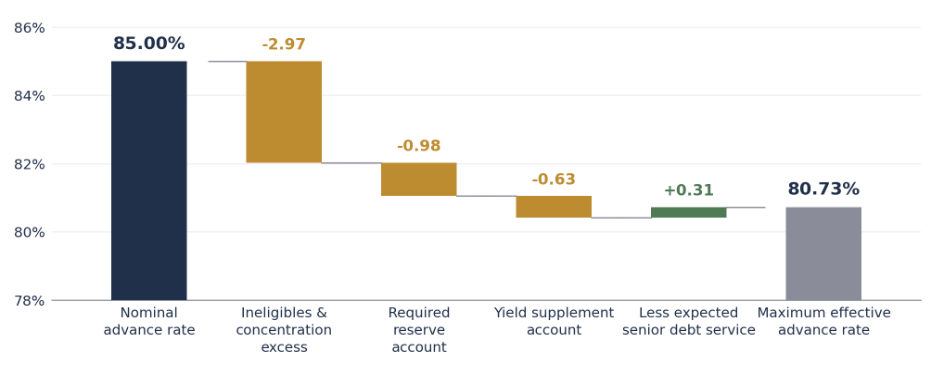
Figure 2 Structural bridge for the illustrative facility. Each component is a term in the documents, not an operating choice.
| Component | Effect | What drives it | Points |
| Ineligibility and concentration excess | Assets sit in the pool and consume capital but receive no advance. The nominal advance rate on an ineligible asset is zero. | Eligibility criteria, concentration limit definitions, whether a single asset can satisfy multiple excesses | −2.97 |
| Required reserve account | Cash the structure must hold. It is an asset of the transaction and belongs in the denominator. | Required reserve percentage; whether a letter of credit is permitted in lieu of cash | −0.98 |
| Yield supplement or negative carry account | A second funded account serving a specific structural purpose, with the same denominator effect. | Coupon profile of the pool relative to facility cost; sizing methodology | −0.63 |
| Less expected senior debt service | Cash offset by a current liability that is not counted in external debt, so it is deducted from adjusted cash. | Payment date proximity; how tightly the payment date is set to the prior period end | +0.31 |
| Total structural gap | −4.27 |
Table 2 Components of the structural gap. Every line is closable only through structuring or amendment.
The borrower’s mandate. Closing the structural gap means negotiating the terms that create it: letters of credit in lieu of cash reserves, credit for collection account cash net of senior debt service, concentration limit language that allows a single asset to satisfy multiple excesses, tighter eligibility drafting, and payment dates set as close to the prior period end as the structure will bear. Most of these are credit-neutral to the lender. Several are worth more than the enhancement basis points the same team spent months negotiating.
The operational gap: maximum effective to effective
The operational gap is the difference between a facility as documented and a facility as run. Unlike the structural gap it is not fixed, it is not visible in any transaction document, and it is recreated every day. It is also, in our experience, the larger of the two.
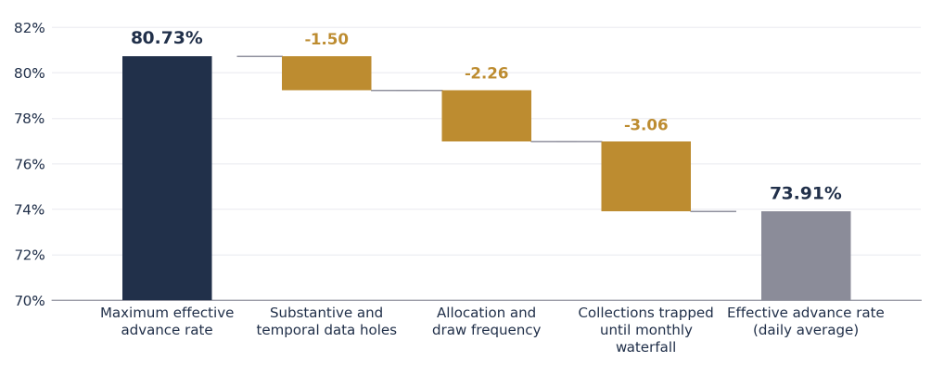
Figure 3 Operational bridge for the illustrative facility, measured as a daily average across two full collection periods.
Substantive and temporal data holes
A substantive hole exists when the issuer owns a financeable non-cash asset that either does not appear at all in the reporting that drives the borrowing base, or appears without the attributes needed to value it — a missing coupon that makes a yield supplement calculation impossible, for example. A temporal hole exists when an asset that was in the pool disappears for a period while remaining eligible, typically because an upstream system process removes it before a downstream one reinstates it. A returned lease vehicle that leaves the lease balance on sale before arriving as an asset held for sale is a temporal hole. So is a lease whose balance is reduced on invoicing before the receivables subledger picks up the open billed amount.
Both are invisible without daily asset-level roll-forward reporting, because both usually resolve. A three-week hole that closes is still three weeks during which real collateral generated no financing, and it shows up as a permanent drag on the sponsor-wide effective advance rate.
Allocation and draw frequency
Collateral that has been originated but not yet allocated generates no borrowing base. A facility that has borrowing base capacity but has not been drawn generates no debt. Both are frequently a bandwidth problem rather than a structural one: reporting packages that take days to produce, or operations teams that allocate and draw on a cadence set by their workload rather than by origination volume.
Collections trapped until the monthly waterfall
This is the single largest operational component in most revolving structures and the least defensible. Cash collected on day two of a collection period and held until a waterfall run on the payment date of the following month is cash that sits in the denominator for weeks while producing nothing. Even where a structure gives credit for collection account cash, the benefit cannot be realized if the cash is locked until a single monthly waterfall run — it simply converts to negative carry.
The remedy is either daily access to calculated available cash for the purpose of topping up collateral, or, preferably, a full waterfall run on a daily basis, releasing cash to the issuer to be distributed or redeployed. This is a data and computation problem that was solved some time ago. Granite Pass has operated daily settlement for the transactions it administers since 2013.
| Component | How it presents | Where it is fixed | Points |
| Substantive and temporal data holes | Financeable assets absent from, or incompletely described in, borrowing base reporting | Source system mapping; daily asset-level roll-forward reporting | −1.50 |
| Allocation and draw frequency | Originated collateral unallocated; available capacity undrawn | Reporting automation; financing operations cadence and staffing | −2.26 |
| Collections trapped until monthly waterfall | Collection account cash accumulating through the period with no financing effect | Daily waterfall operation or daily top-up rights | −3.06 |
| Total operational gap | −6.82 |
Table 3 Components of the operational gap. Every line is within the sponsor’s control without amending a document.
Calculating the rates
The effective advance rate is the quotient of total external debt and total adjusted assets. Both terms require definition, because the value of the measure depends entirely on applying them consistently.
Total external debt
All debt outstanding, less any debt held by an affiliate of the sponsor, whether a retained debt security or an intercompany loan forming part of the issuer’s capitalization. Excluding retained and affiliate debt is deliberate: the measure is intended to show how much financing the market has actually provided against the pool, and how well the issuer draws on it.
Total adjusted assets
Total adjusted assets is the sum of non-cash assets and adjusted cash assets.
Non-cash assets are the entire balance of assets in the structure that are not cash or cash equivalents — loans, leases, receivables, vehicles — without regard to eligibility or concentration limits. The purpose is to capture the full asset value the structure is carrying. Eligibility criteria and concentration limits reduce the effective advance rate precisely because they gross up assets against which no financing is provided, and that is the effect the measure is designed to reveal.
Cash assets begin with all cash available to the transaction, in collection accounts and reserve accounts of every description, and are then adjusted twice. First, non-cash liquid enhancement such as a letter of credit standing in place of a cash reserve is added, because the structure would otherwise require cash and the sponsor is using the letter of credit for capital efficiency. Second, expected senior debt service on the coming payment date is deducted, because that cash is offset by a current liability that is not included in external debt.
| Line item | Amount ($) | Note |
| Panel A — Effective advance rate (daily average, two collection periods) | ||
| Total external debt outstanding | 782,000,000 | Net of retained and affiliate debt |
| Total non-cash assets | 1,000,000,000 | Full pool, before eligibility and concentration |
| Available funds in collection account | 42,000,000 | Accumulating until the monthly waterfall |
| Reserve account balance | 12,000,000 | |
| Yield supplement account balance | 8,000,000 | |
| less Expected senior debt service | (4,000,000) | Offset by a current liability not in external debt |
| Total adjusted cash | 58,000,000 | |
| Total adjusted assets | 1,058,000,000 | |
| Effective advance rate | 73.91% | |
| Panel B — Maximum effective advance rate | ||
| Eligible collateral | 965,000,000 | Pool less $20mm ineligible and $15mm concentration excess |
| Maximum external debt at 85.00% nominal | 820,250,000 | Facility drawn to its contractual ceiling |
| Total non-cash assets | 1,000,000,000 | Ineligible assets remain in the denominator |
| Required reserve account | 12,000,000 | |
| Required yield supplement account | 8,000,000 | |
| less Expected senior debt service | (4,000,000) | |
| Total adjusted cash at structural minimum | 16,000,000 | No trapped collections |
| Total adjusted assets | 1,016,000,000 | |
| Maximum effective advance rate | 80.73% | |
| Panel C — Nominal advance rate | ||
| Contractual advance rate against eligible collateral | 85.00% | As documented |
Table 4 The three rates calculated on a common basis for a $1 billion illustrative revolving facility. Figures are illustrative.
The denominator is the whole point. Note that the same $1,000,000,000 of non-cash assets appears in Panels A and B. Ineligible assets, concentration excess and required reserve cash do not leave the structure because the credit agreement declines to give them credit. They remain assets the sponsor is funding, and a measure that removes them from the denominator will report a comfortable number while the capital sits idle.
Why a reporting-date measurement is misleading
Calculating effective advance rate on a single day — typically the last day of the collection period, to tie to the servicer reporting package — will usually overstate it, for two reasons.
1. In a revolving structure, that particular day is more likely than any other to have been actively managed for a reported result. Whether the same care is applied to the other days of the period is knowable only by looking at those days.
2. In a facility operating on a monthly waterfall release cycle, which is most of them, the cash balance on the last day of the period is not the structural cash balance of the transaction. It is the peak of an accumulation that has been building all month.
An accurate view requires a daily calculation across at least two full collection periods, from which an average can be taken. The shape of the daily series is itself diagnostic: a sawtooth means cash is being trapped, and a spike confined to the reporting date means the facility is being managed to the report rather than to the economics.
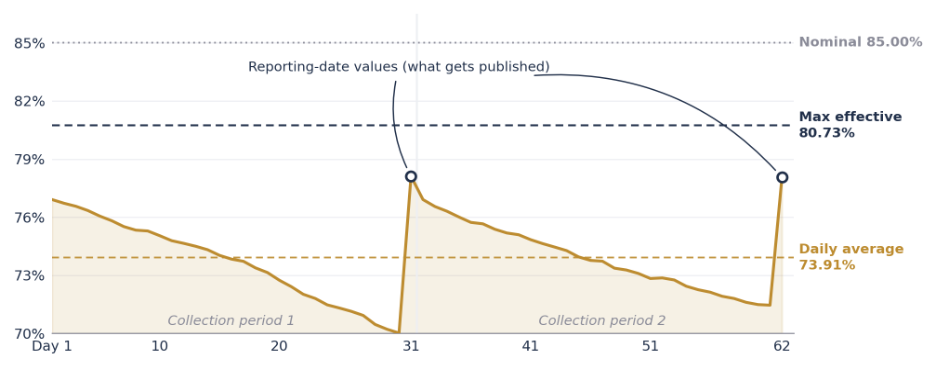
Figure 4 Daily effective advance rate across two collection periods. The reporting-date values of roughly 78 percent overstate the daily average of 73.91 percent by more than four points.
What the shape tells you. A facility whose daily effective advance rate declines steadily through the period and recovers only on the reporting date is not a facility with a measurement problem. It is a facility with a cash-recycling problem, and the reporting-date number is the one figure that conceals it. This is the same discipline Granite Pass applies to cash verification: measure daily, against connected data, or accept that the control is describing a single managed day.
What a point of effective advance rate is worth
Holding assets in a securitization in excess of what the structure requires is an unnecessary use of corporate — meaning non-securitization — capital. In most cases corporate capital is more expensive than securitization capital, and the appropriate charge for the excess is a matter on which reasonable corporate finance views differ.
The most conservative approach is to charge the incremental after-tax cost of revolving corporate debt, net of the effect on unused line fees. We regard this as too low: there are few situations in corporate finance where the incremental cost of revolving debt is the right capital charge for a project. The middle ground, and in our view the right answer for most sponsors, is a weighted average after-tax cost of corporate debt or a weighted average cost of corporate capital, with the choice depending on the sponsor’s capital structure philosophy. The most aggressive approach charges the cost of equity, which is appropriate only where the released capital would in fact be distributed to shareholders.
Where the excess assets are cash held in interest-bearing accounts, interest earned should be netted against the charge. Where the structure would permit incremental financing against the pool and the proceeds could be distributed to the sponsor, no such netting is conceptually required.
| Capital released | Points | Amount ($) | After-tax cost of debt 5.70% | WACC 11.0% | Cost of equity 16.0% |
| Closing the structural gap | 4.27 | 42,700,000 | 2,433,900 | 4,697,000 | 6,832,000 |
| Closing the operational gap | 6.82 | 68,200,000 | 3,887,400 | 7,502,000 | 10,912,000 |
| Both, in full | 11.09 | 110,900,000 | 6,321,300 | 12,199,000 | 17,744,000 |
Table 5 Annual value of advance rate improvement on the illustrative $1 billion facility. Capital charges shown are the after-tax cost of corporate debt (7.5 percent gross, 24 percent tax rate), the weighted average cost of corporate capital, and the cost of equity. Each point of effective advance rate releases $10 million of corporate capital.
On this facility, the operational gap alone is worth $7.5 million a year at a weighted average cost of capital. It requires no amendment, no lender consent and no credit concession. It requires the facility to be run daily against complete data.
Two mandates, two owners
The practical value of separating the three rates is that it separates accountability. The two gaps are closed by different people using different tools on different timescales, and conflating them is how both go unaddressed — treasury assumes operations will make up the difference, operations assumes the structure is what it is.
| The borrower’s mandate | Program administration’s mandate | |
| Objective | Move the maximum effective advance rate toward the nominal advance rate | Move the effective advance rate toward the maximum effective advance rate |
| Gap addressed | Structural | Operational |
| Instruments | Structuring, amendment, negotiation at renewal or on the next transaction | Systems, data completeness, reporting automation, operating cadence |
| Typical actions | Letter of credit in lieu of cash reserve; credit for collection account cash net of debt service; concentration language permitting a single asset to satisfy multiple excesses; tighter payment date; eligibility drafting | Daily borrowing base and waterfall calculation; elimination of substantive and temporal data holes; concentration optimization without double counting excesses; collateral allocation optimization across the financing complex; increased draw frequency |
| Timescale | Renewal cycles and amendment windows; often years to fully realize | Immediate, and measurable daily |
| Evidence of success | Maximum effective advance rate rises | Effective advance rate converges on the maximum effective advance rate, and the daily series flattens |
Table 6 The two mandates. Neither substitutes for the other.
Where the ceiling actually is. For every facility there is a practical limit, even after structural improvement, on how close the effective advance rate can get to the nominal advance rate. Treasurers should be mandated to find that ceiling and then manage as close to it as the structure permits, absent a compelling corporate finance reason to hold excess collateral — no revolving corporate debt to repay and genuinely surplus corporate cash being the obvious example.
What effective advance rate does not tell you
A measure is credible in proportion to the clarity with which its boundaries are stated. Effective advance rate is a financing efficiency metric. It is not a credit metric, and it should not be read as one.
— It says nothing about asset quality. A pool of poorly underwritten collateral financed efficiently will produce an excellent effective advance rate right up until it does not perform. Advance rate efficiency and credit performance are independent questions.
— It does not validate the collateral. The measure takes the reported pool balance as given. Whether those assets exist, were properly originated, and are generating genuine third-party collections is the subject of separate controls, including cash verification and custodial file review.
— A higher number is not always the right answer. There are legitimate corporate finance reasons to run a facility below its ceiling. The measure’s purpose is to make that a decision rather than an accident.
— It is not comparable across sponsors without a common methodology. Because no market standard exists, two sponsors reporting effective advance rates calculated on different denominator conventions are not reporting the same thing. Internal consistency over time is where the value lies.
— Amortizing term structures will show the tightest spreads. Their fire-and-forget nature leaves little room for operational drag. Revolving facilities, and master trusts in particular, show much wider variances — which is precisely why the measure matters most there.
Why this matters to each party
| Party | What the three-rate framework provides |
| Treasurers and CFOs | A financing efficiency KPI that is comparable period over period and decomposable into actions, rather than a headline rate that cannot be managed. |
| Boards and audit committees | Visibility into whether negotiated financing capacity is actually being used, and a basis for asking why it is not. |
| Program administrators | A defined target — the maximum effective advance rate — and a daily measure of progress toward it. |
| Structuring teams | Quantification of which contractual terms are expensive, allowing negotiation effort to be directed where the value is rather than only at enhancement levels. |
| Lenders and investors | Insight into the operational quality of a sponsor’s financing platform. A facility run at a wide and volatile operational gap is telling you something about the sponsor’s systems. |
| Rating agencies | A view of the operating control environment surrounding the pool, not only its credit characteristics. |
Table 7 The three-rate framework viewed from each seat in the transaction.
Conclusion
Securitization’s value in cost of capital terms is too high to leave points of it unclaimed. Yet the market continues to measure financing efficiency with a number that describes an entitlement, and to spend months negotiating basis points of enhancement while surrendering whole points to a monthly waterfall cadence and an incomplete data feed.
The remedy is not complicated. Calculate all three rates on a consistent basis. Measure the effective rate daily, across at least two full collection periods, and look at the shape of the series and not only its average. Decompose each gap into named components with an owner. Assign the structural components to treasury and the operational components to program administration, and report both.
The objection to this level of measurement was once practical rather than philosophical. Daily borrowing base and waterfall calculation across a portfolio of any size required building the infrastructure first, and reconciling it in spreadsheets was not realistic. That was a fair objection. It is no longer one. Granite Pass has operated this way since 2013, when the capability had to be built rather than configured, and the cost of running it today is immaterial against the capital it releases.
Final takeaway. The nominal advance rate is what you negotiated. The maximum effective advance rate is what your documents will allow you to achieve. The effective advance rate is what you actually got. The first is a headline, the second is a target, and only the third is a result — and the distance between them is measured in tens of millions of dollars of capital, every year, on a single facility.
Companion papers. This paper is one of a series on structured finance operating discipline. Law of Conservation of Asset Principal sets out the framework for tracking asset value as it moves from cash, to principal, to receivable, and back to verified cash. Cash Verification: The First Line of Fraud Deterrence explains why independently evidenced cash is the strongest early control against fraud. Effective advance rate measures how efficiently a structure uses the value those two papers are concerned with proving.
Disclaimer. This paper is provided for informational purposes only and does not constitute legal, accounting, tax or investment advice. All facility terms, portfolio balances, rates and capital cost assumptions used in the illustrations are hypothetical and are presented solely to demonstrate the calculation methodology. Actual results depend on transaction-specific terms and operating circumstances.